Monument history
INAUGURATION: 1920
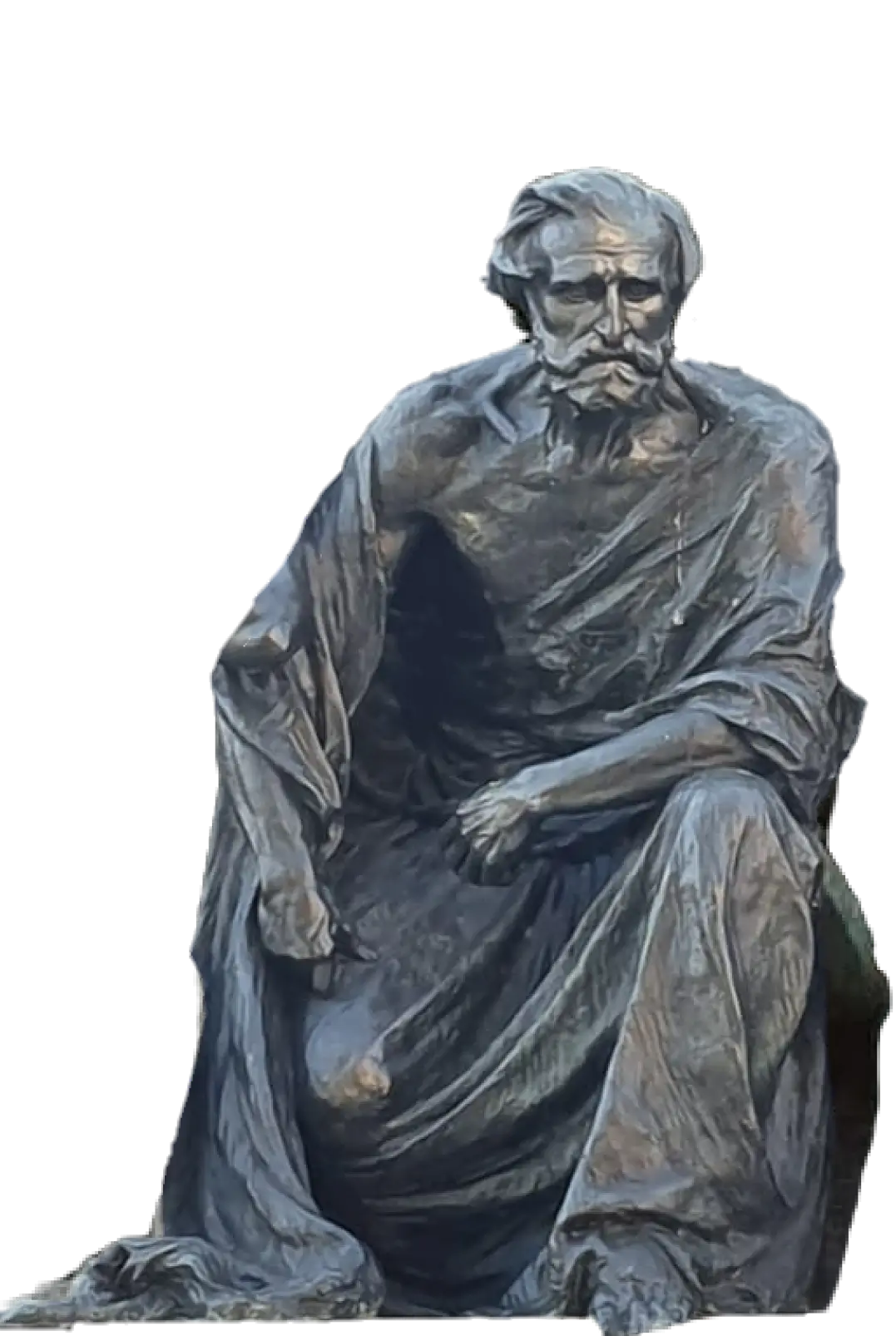
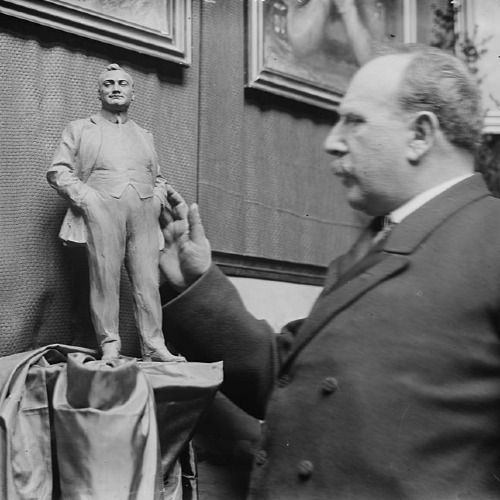
The monument to Giuseppe Verdi was commissioned by the city of Parma to mark the centenary of the composer's birth. The work was designed by the architect Lamberto Cusani. The sculptural decoration was entrusted to the Palermo-born sculptor Ettore Ximenes, with the participation of several young sculptors from Parma, including Alessandro Marzaroli, author of the Monument to Corridoni.
Work on the monument began in 1913, on the occasion of the centenary of Verdi's birth, and it was inaugurated in 1920. It was originally placed in the square in front of the railway station. The monument consisted of a 120-metre-long semicircle with a triumphal arch at its center and, along the sides between the arches, statues representing Verdi's operas. In the middle of the area stood an altar decorated with bronze reliefs.
On May 13, 1944, an air raid damaged the monument. Although it was only partially destroyed, it was decided to demolish the remaining structure to make way for new buildings. The only surviving elements today are the central altar, which was relocated to Piazzale della Pace near the Palazzo della Pilotta, and nine statues representing nine of Verdi's operas, now displayed at the Arena del Sole Theatre in Roccabianca, in the province of Parma, including the statues of Aida, Don Carlos, and Ernani.
THE ALTAR, made of granite and bronze, features on its front a bronze high relief depicting Verdi in meditation, surrounded by various muses representing, in order, inspiration, melody, song, the rhythm of dance, love, and death.
The back is divided into three separate high reliefs depicting three episodes linking Verdi and the city of Parma to the unification of Italy, in sequence:
- The approval by the provinces of Parma of the annexation to the Kingdom of Italy.
- The scene featuring the famous acronym VIVA V.E.R.D.I.
- The presentation of the plebiscite results by Verdi and the other delegates to the King.
In Parma, Emilia-Romagna
Giuseppe Verdi
1813 - 1901
GIUSEPPE VERDI (1813–1901)
Giuseppe Fortunino Francesco Verdi was born in Le Roncole di Busseto on October 10, 1813.
From an early age, he received organ lessons from the village organist, practicing on an out-of-tune spinet given to him by his father. In 1832 he moved to Milan, where he applied to the Conservatory but was not admitted because his hand position was considered incorrect and because he had exceeded the age limit. Shortly afterward, he returned to Busseto to serve as the town's music teacher.
In the following years, he demonstrated his extraordinary talent as a composer, focusing from the very beginning on opera. He made his debut in 1839 with Oberto, Count of San Bonifacio at La Scala in Milan, achieving moderate success. Three years later, again at La Scala, Nabucco established him as one of Italy's leading composers. Between 1842 and 1848 he experienced what he himself called his "galley years," a period of intense creative work during which he composed operas such as I Lombardi alla prima crociata, Ernani, I due Foscari, Macbeth, I masnadieri, and Luisa Miller.
In 1848 he moved to Paris with his partner Giuseppina Strepponi, the celebrated soprano who had previously collaborated with him in Milan. During the following five years he composed the famous Popular Trilogy—Rigoletto, Il Trovatore, and La Traviata—three operas that achieved extraordinary success and are still regarded as masterpieces of opera.
Italy developed a unique musical genre known as melodrama, combining music and theatre to tell powerful and dramatic stories. Among all opera composers, Verdi is considered the most prolific and one of the greatest. He composed 27 operas, a Requiem Mass in memory of Alessandro Manzoni, and many other works, bringing Italian opera to the world's leading theatres.
Although his music is deeply dramatic, his operas are rooted in Romanticism, telling stories of passionate love, sacrifice, and tragic destiny. The arias and duets from works such as Rigoletto, Il Trovatore, and La Traviata remain among the most famous pieces in the entire operatic repertoire.
His final masterpieces include Otello (1887) and Falstaff (1893), both with librettos by Arrigo Boito inspired by the plays of William Shakespeare. With Falstaff, at the age of eighty, Verdi concluded his theatrical career and retired to his estate at Sant'Agata.
Alongside his artistic career, Verdi also played an important role in Italian public life. After the unification of Italy, he was elected a member of the first Italian Parliament, and in 1874 he was appointed Senator of the Kingdom of Italy.
Verdi's name is also closely linked to the Italian Risorgimento. During the struggle for national unity, the famous slogan "Viva Verdi" became a patriotic message: the letters of his surname formed the acronym for "Viva Vittorio Emanuele Re d'Italia" ("Long live Victor Emmanuel, King of Italy"), allowing supporters of Italian unification to express their views without attracting censorship.
Verdi's life was also marked by profound personal tragedy. He lost both his wife and his two children at a young age. These experiences likely contributed to his reserved character and influenced the emotional depth of his music.
Giuseppe Verdi died in Milan in 1901. In accordance with his wishes, his funeral was held without pomp or music, reflecting the simplicity that had characterized his entire life.
Also discover:
Mat Sicuri
Listen to the statue by calling
+39 0521 183 0425,
or click the button below