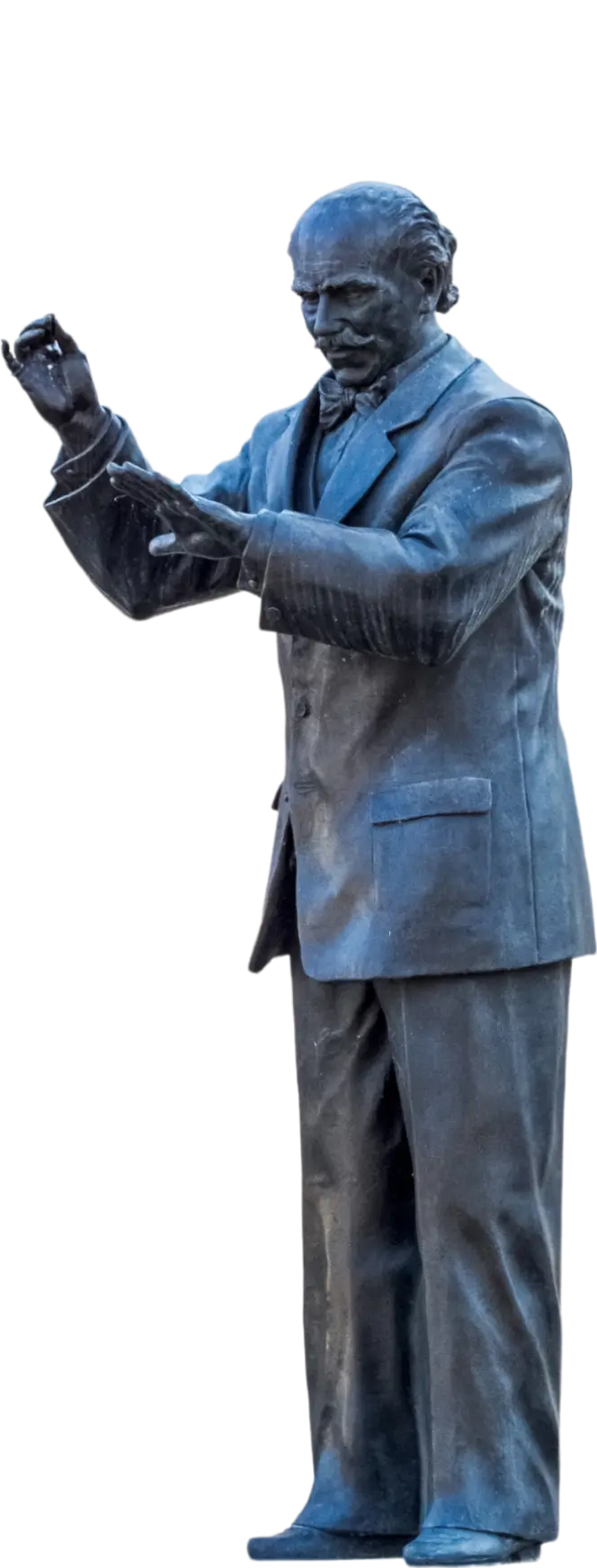
Realized by
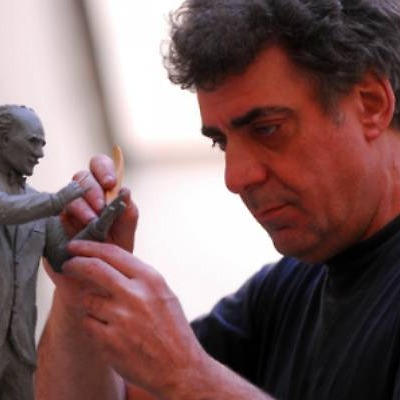
Maurizio Zaccardi
Birth: 1955
Monument history
FIRST LOCATION (Vicolo Asdente): 2007
RELOCATION AND INAUGURATION (Former Eridania Park): 2017
By taking part in the project “Talking Teens – The Statues Speak!”, our class, the second year of the European High School at the Convitto Nazionale Maria Luigia (2018–19), had the opportunity to give a voice to the statue of Arturo Toscanini.
We were invited to "adopt" this statue because of the proximity of the former Eridania Park, where it is located, to our school. Just a short walk was enough for us to observe it up close.
We know that the statue was originally intended to be placed in front of Arturo Toscanini's birthplace, a Gothic building in the Oltretorrente district. From June 2009 to March 2017, the statue "conducted" at the Barilla Center. Today, however, it stands in front of the Arturo Toscanini Foundation and a short distance from the Paganini Auditorium—a location that has sparked mixed reactions among local residents.
As for its technical features, the statue is made of bronze, stands 2.10 metres tall, and is supported by a pedestal.
Created by the Italian sculptor Maurizio Zaccardi, the statue was erected in 2007. In addition to the year of its creation and the mark of the foundry where the bronze was cast, the artist's signature is engraved on the left ankle.
Toscanini is depicted in his most familiar role: conducting an orchestra. He originally held a baton, but following repeated acts of vandalism, it was stolen several times.
Furthermore, the Maestro is portrayed looking directly at his orchestra rather than at the music stand, in order to coordinate the musicians. This choice reflects Zaccardi's intention to recall Toscanini's extraordinary memory—he knew musical scores by heart—and his famous "fiery eyes." Those who knew Arturo Toscanini often recalled the intense expression he had whenever he cared deeply about something, especially music, to the point that he could think of nothing else.
In Parma, Emilia-Romagna
Arturo Toscanini
1867 - 1957
Arturo Toscanini was born on March 25, 1867, in Parma, a city he left after his early childhood. The son of two tailors, Claudio Toscanini and Paola Montani, Arturo was inspired by his father, who often went to the theatre. However, it was not his father who discovered his talent, but one of his teachers, Mrs. Vernoni. She noticed Arturo's remarkable ability to memorize poems after hearing them only once and decided to give him free lessons in music theory and piano. After only a few lessons, Mrs. Vernoni suggested that his parents enroll him in the Royal School of Music, now the Conservatory of Parma. At the age of nine, Arturo entered the school, immediately earning a scholarship. In the following years, he studied the cello under renowned teachers, including Leonardo Carini. In 1885, he graduated with honors.
In 1886, he joined an opera company touring South America as a cellist. It was in Brazil that his brilliant career as a conductor began.
On June 30, 1886, Aida by Verdi was to be performed in Rio de Janeiro, but the conductor Leopoldo Miguez left the company after only one performance. Carlo Superti was asked to replace him, but after repeated protests from the audience, he also gave up. Encouraged by several musicians, who knew how thoroughly he knew the score, Toscanini closed the music book, took the baton, and began conducting the orchestra brilliantly, achieving enormous success.
After returning to Italy, he continued his career in Milan, while also composing several works for voice and piano.
In 1898 he began conducting at La Scala. He became the artistic director of the famous Milanese theatre and, inspired by Richard Wagner, sought to revolutionize the way opera was performed. Thanks to him, the auditorium lights were turned off during performances, audiences were encouraged to show greater respect for theatrical productions, latecomers were no longer admitted, and ladies were asked not to wear hats so that those seated behind them could enjoy a better view. These changes caused considerable controversy, since at the time the theatre was regarded more as a social gathering place than as a cultural institution.
Because of his opposition to Fascism, Toscanini severed his ties with Italy and moved to New York, declaring that he would never set foot in his homeland again as long as the dictatorship remained in power—and he kept his word.
He also became widely admired in the United States. "The Maestro" was famous for his extraordinary memory, conducting without ever reading the musical score.
On April 4, 1954, for the first time, he lost his concentration and forgot a passage. At that moment he realized that his extraordinary career had come to an end, and shortly afterward he retired from the stage. He was 87 years old and had enjoyed a lifetime of success.
He died in 1957 near New York and is buried in the Monumental Cemetery of Milan.
Toscanini was a man of great determination. He lived through the years of Nazism and Fascism but never yielded to either. For this reason, the moral and civic legacy he left behind remains of immense importance. Even before our admiration for him as a musician comes our respect for him as a great free man, who always held his head high in times of dark oppression and servility.
Also discover:
Correggio
Listen to the statue by calling
+39 0521 183 0428,
or click the button below