Realized by
Agostino Ferrarini
1828 - 1898
Monument history
INAUGURATION: 1870
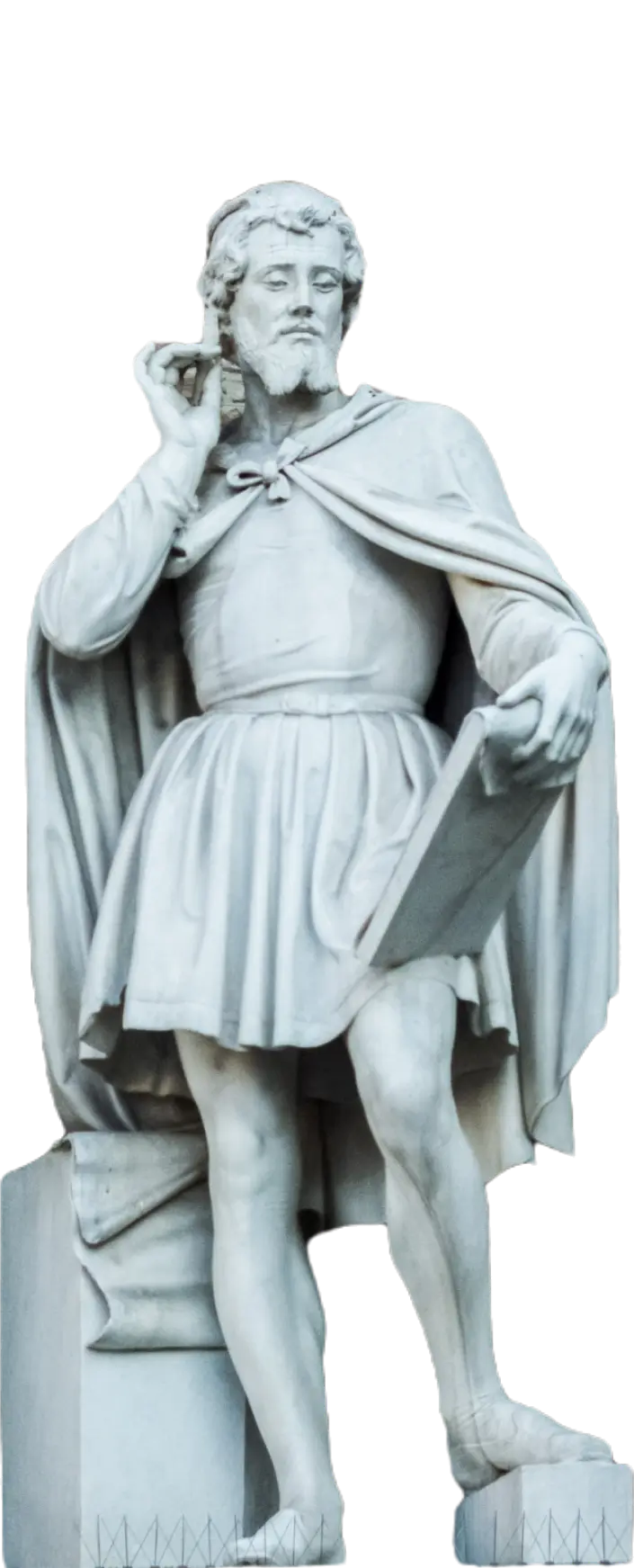
During the early years of his artistic training, Ferrarini designed and modeled the monument to Correggio in Florence. The statue was then created on behalf of the city's Academy of Fine Arts between 1869 and 1870. Ferrarini decided to donate his work free of charge, while the expenses for the pedestal, made of Verona limestone, were covered through a public subscription launched in the newspaper Gazzetta di Parma and later supplemented by the Municipality after several years of waiting.
The monument was finally installed on the night of September 10, 1870, without an official inauguration, perhaps for fear of provoking unrest among a population already suffering from severe economic hardship.
Since its completion, the monument, which depicts Correggio observing one of his own works while resting it on his knee with one hand and holding a paintbrush close to his ear with the other, as if about to correct his own execution, has been the victim of repeated misfortunes. These include the statue's head falling off while the sculptor was still working on it and, in 1982, the same head being struck by lightning, causing it to crash to the ground.
In Parma, Emilia-Romagna
Correggio
1489 - 1534
Antonio Allegri, known as CORREGGIO (1489–1534), was born in Correggio around 1489. He spent most of his life in Parma, where his artistic training was shaped by masters such as the great Andrea Mantegna. Through the expressive sweetness of his figures and his masterful use of perspective, Correggio established himself as the most innovative interpreter of the ideals of the Renaissance. He introduced a new way of conceiving painting and developed a highly original artistic style, earning his place among the great masters of the sixteenth century and the title "The Painter Who Painted Air." On March 5, 1534, after a short illness, he died in Correggio. Some of his most important works can be found in Parma.
WORKS:
CAMERA DI SAN PAOLO: A late Gothic umbrella vault frescoed by Correggio around 1519, commissioned by Giovanna da Piacenza, abbess of the Monastery of San Paolo. Through a masterful illusionistic effect, the artist transformed the enclosed ceiling into a pergola. In the lunettes are small figures, Olympian deities and symbolic images painted in the round. The structure rests on painted capitals decorated with ram's heads. The choice of secular themes is probably connected to the patron's refined cultural background and the circle of humanists who frequented the monastery. The interpretation of the fresco is still debated by scholars today.
DOME OF SAN GIOVANNI: Commissioned by the Benedictine monks of the Abbey of San Giovanni for their church, the fresco was painted between 1520 and 1524. Here Correggio demonstrates his revolutionary artistic vision by dissolving the architectural structure and opening it onto a limitless space. At the highest point, in the center of a golden sky, stands the figure of Christ, seen in dramatic foreshortening from below as he descends toward Saint John.
MADONNA OF SAINT JEROME, known as "THE DAY": This painting was created between 1526 and 1528 for the Bergonzi Chapel in the Church of Saint Anthony. After becoming war booty during the Napoleonic campaigns and spending time in the Louvre, it is now housed in the National Gallery of Parma.
ASSUMPTION OF THE VIRGIN: This fresco decorates the dome of Parma Cathedral and was painted between 1520 and 1530. Correggio transformed the architectural structure of the dome, consisting of an octagonal drum supporting a hemispherical vault, opening the enclosed space of the church into an infinite sky. The illusion of a sky filled with voluminous clouds and the upward movement of Mary, contrasted with the downward movement of Christ, is achieved through the countless poses of the many moving figures that surround the viewer in this heavenly vortex.
RETURN FROM THE FLIGHT INTO EGYPT, known as "THE MADONNA OF THE BOWL": This panel painting was created by Correggio for the Church of the Holy Sepulchre in Parma between 1528 and 1530. The work illustrates an episode from the childhood of Jesus, narrated in the apocryphal Gospels: during the return journey from Egypt, the Holy Family is said to have been nourished by a date palm that bent down to offer them its fruit. Today the painting is preserved in the National Gallery of Parma. The National Gallery also houses other masterpieces by Correggio, including Lamentation over the Dead Christ, Martyrdom of Four Saints, and the detached frescoes of the Annunciation, the Coronation of the Virgin, and the Madonna della Scala.
Also discover:
Filippo Corridoni
Listen to the statue by calling
+39 0521 183 0420,
or click the button below