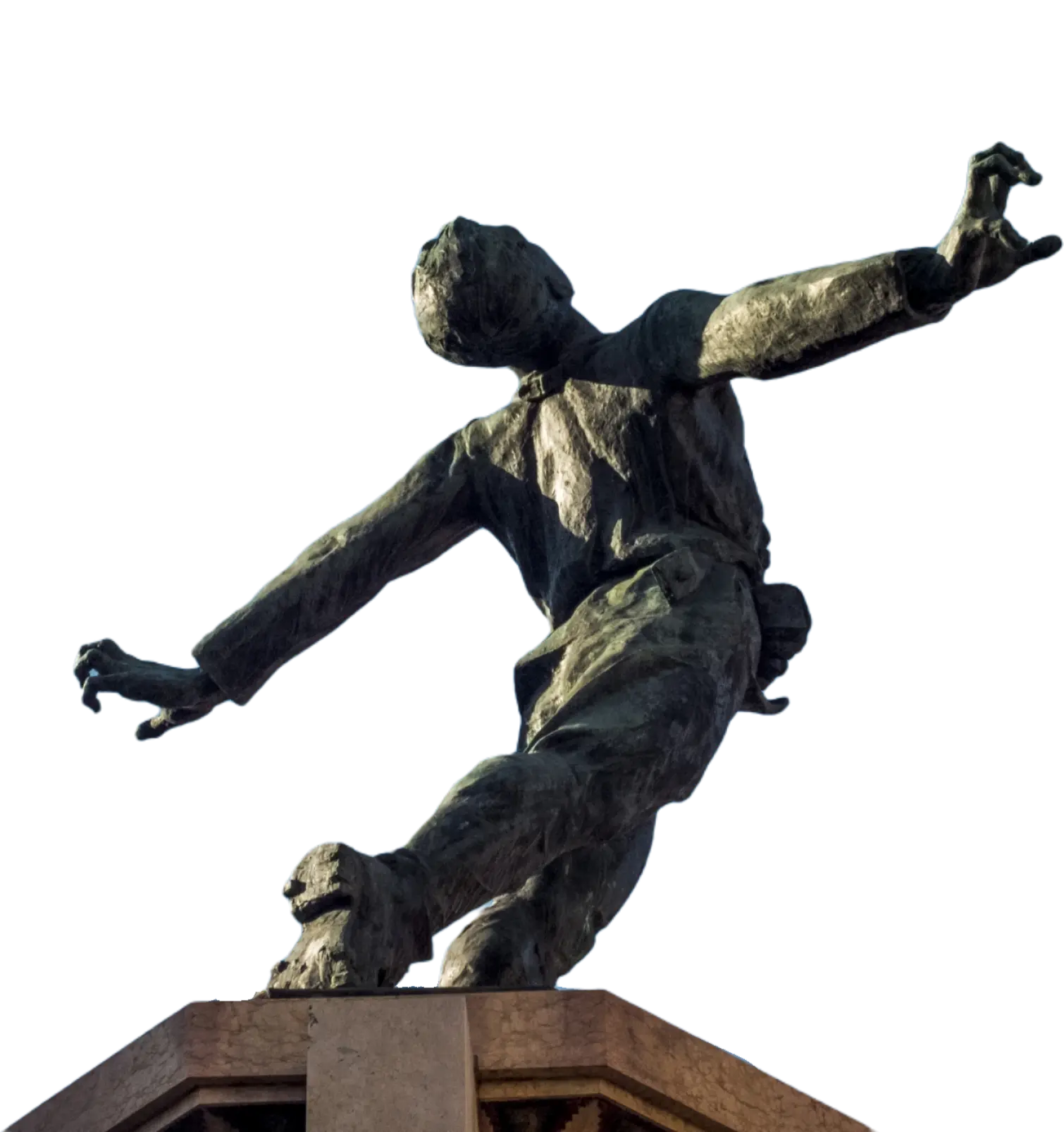
Realized by
Alessandro Marzaroli
1868 - 1951
Monument history
INAUGURATION: 1927
Authors: Overall design by the architect Mario Monguidi, bronze sculpture by Alessandro Marzaroli.
Date of installation: The monument was inaugurated by Edoardo Rossoni on October 30, 1927.
Materials: Verona breccia for the base – Botticino marble and mosaic for the shaft – Bronze for the statue.
State of conservation: Excellent (restored in 2008 by Paolo Somacher and Guglielmo Gaiani).
Description: The 4-metre-high statue depicts the death of Corridoni, struck in the chest by a bullet during the First World War. Carved into the shaft are allegories of poverty, faith, love, and the flame, symbolizing the ideals that guided the life of the trade union hero. The square base is decorated with four eagle heads and four human heads; below them are four inscriptions, only two of which remain legible today.
Historical background: The monument was erected at the site where the people of Parma repelled the Fascist squads in 1922. Mussolini personally approved the project with words of enthusiasm. On the one hand, it was intended as an "act of reconciliation" with the Oltretorrente district, which was the subject of an extensive urban renewal plan. On the other, it represented an attempt to appropriate the image of a popular hero, presenting him as a symbol of the patriotic values of the new regime.
Inscriptions:
North side of the base: TO FILIPPO CORRIDONI / WHO EMBRACED IN HIS NOBLE HEART / ALL THE PASSIONS OF THE ITALIAN PEOPLE / SANCTIFYING THEM / VOLUNTEER OF DEATH AND GLORY / AMID THE SONGS OF THE FATHERLAND / ON THE BLOOD-STAINED CALVARY OF THE FRASCHE
South side of the base: TWENTY-EIGHTH OF OCTOBER, YEAR V
In Parma, Emilia-Romagna
Filippo Corridoni
1887 - 1915
Filippo Corridoni was born in 1887 in Pàusula, now Corridonia (Macerata), into a working-class family.
He attended the Industrial Institute of Fermo, where he developed a passion for the writings of Carlo Pisacane, Mazzini, and Marx, and began dedicating himself to the defense of the most vulnerable.
In 1905, he moved to Milan, where he worked as a metalworker, embraced socialism, and in 1907 became secretary of the youth section of the Italian Socialist Party.
In 1911, he opposed the war in Libya, believing it would lead to a crisis at the expense of workers. He founded several revolutionary newspapers: Bandiera Rossa, Bandiera Proletaria, and Bandiera del Popolo, and became involved with the Italian Syndicalist Union (USI).
With the approval of Mussolini, then editor of Avanti!, he founded the USM (Milanese Trade Union), but was arrested shortly afterward. Over the course of his life, he served a total of five years in prison and also experienced exile in France and Switzerland.
After returning to Italy, he arrived in Parma under the pseudonym Leo Celvisio. He took part in farm workers' strikes and developed close ties with the De Ambris brothers, leading figures of the Parmese trade union movement. In 1915, he embraced interventionism, expressing his support for Italy's entry into the war. The German trade unions had declared that they were Germans first and workers second: Corridoni's dream of an international syndicalist movement came to an end.
He left for the front on July 25, 1915, despite suffering from tuberculosis for many years. Witnesses recalled that, when the attack signal was given, he was always among the first to charge toward the enemy trenches, standing upright and waving his cap while shouting, "Victory! Long live Italy!"
He died on the Karst, at the Trincea delle Frasche, on October 23, 1915, while the Italian army was attempting to open the way to Gorizia. His body disappeared amid the fighting. He was posthumously awarded the Silver Medal for Military Valor, later upgraded to the Gold Medal.
His interventionism, heroic death, the accounts of those who were with him during his final hours, and the mystery surrounding his never-recovered body all contributed to his political appropriation. The image of Corridoni as a Fascist hero reached its peak in 1931, when Pàusula was officially renamed Corridonia.
After the fall of Fascism, however, his association with the celebrations promoted by Mussolini's dictatorship caused his figure to fall into relative obscurity. Historical studies of Corridoni have long been influenced by this legacy, but in recent years scholars have begun a critical reassessment of his life and work, thanks in part to the efforts of cultural associations dedicated to him in Parma, Milan, and Corridonia, where the Filippo Corridoni Museum has been established in his birthplace.
Also discover:
Hercules and Antaeus - Replica
Listen to the statue by calling
+39 0521 183 0418,
or click the button below