Realized by
Jean-Baptiste Boudard
1710 - 1768
Monument history
Creation: 1765
Inauguration: 1769
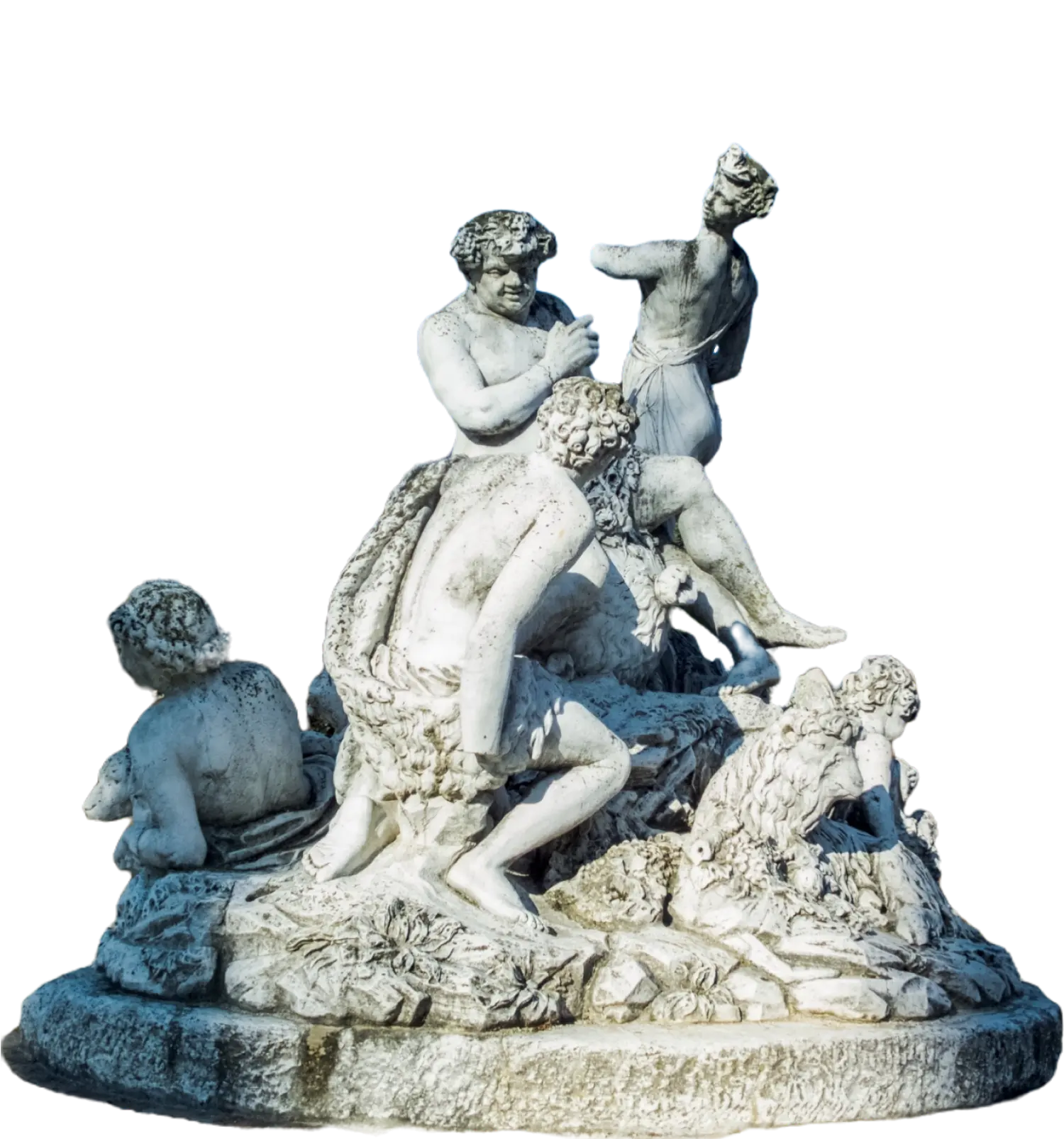
The Group of Silenus was sculpted by the French architect Jean-Baptiste Boudard (1710–1768) in 1766.
The Group of Silenus was completed in 1765 but was inaugurated in 1769 with the performance "The Shepherdesses of Arcadia," staged beside the sculpture on the occasion of the marriage of Ferdinand of Bourbon and Maria Amalia of Austria. The Group of Silenus was placed in the Ducal Garden near the Temple of Arcadia, but the original has been replaced in recent years by a copy made of marble powder and resin in order to protect it from deterioration and vandalism.
Other works by Boudard in the city
Many of his sculptures are preserved just a short walk from the Ducal Park at the Toschi Art Institute and the Parmense Academy of Fine Arts, founded by Du Tillot, where the artist taught alongside Petitot. Other works by Boudard that can still be admired in the city include the Crowned Virgin in the niche of the Governor's Palace in Piazza Garibaldi and the vases of the Casinetto along Viale Martiri della Libertà.
Boudard died at the age of 58 in Sala Baganza, in the province of Parma, where he had retired to seek treatment for dropsy. He was buried in the parish church, where he is commemorated by a memorial plaque.
In Parma, Emilia-Romagna
Sileno
The subject that inspired Jean-Baptiste Boudard to sculpt the Group of Silenus comes from the Sixth Eclogue of Virgil's Eclogues. The sculpture depicts the old Silenus embracing the nymph Aegle, while the two young shepherds, Mnasylus and Chromis, stand beside them.
In the Eclogues, Virgil tells how the two shepherds surprise the old Silenus asleep in a cave. Taking advantage of his drunken sleep, they play a prank on him with the help of the nymph Aegle, who stains his face with the juice of blackberries. When Silenus awakens, he begins to sing a series of mythological tales:
[…] The boys, Chromis and Mnasylus,
saw Silenus lying asleep in a cave,
his veins, as always, swollen with the wine of the previous day.
The garlands had slipped from his head and lay scattered,
while a heavy worn-handled cup hung from his hand.
Attacking him—for the old man had often mocked them
by promising them a song—they bound him with his own garlands.
Then Aegle joined them, shyly approaching,
Aegle, the fairest of the Naiads, and while he glanced about,
she stained his brow and temples with crimson berries.
Laughing at the trick, he said, "Why do you bind me?
Set me free, boys; it is enough that you have managed to catch me.
You shall have the song you desire,
and she shall receive another reward." And then he began to sing.
Then you would truly have seen the Fauns and wild beasts dance in rhythm,
and the stiff oak trees sway with their crowns.
THE SILENI
The Sileni belong to Greek mythology. They were regarded as spirits of water and were believed to spend their time among the nymphs. Among them, Silenus himself stood out as the wisest: an old man, fond of wine and gifted with prophecy. According to legend, however, he would utter his prophecies only when intoxicated. Greek mythology also tells that Silenus was the son of a nymph and Pan, the father of the satyrs, and the tutor entrusted with the education of Dionysus, the god of wine.
Also discover:
Winged Victory
Listen to the statue by calling
+39 0521 183 0415,
or click the button below