Monument history
INAUGURATION: 1956
The Partisan Statue is located in Piazzale della Pace in Parma, in front of the Palazzo della Pilotta, near the site where the statue of Victor Emmanuel II once stood.
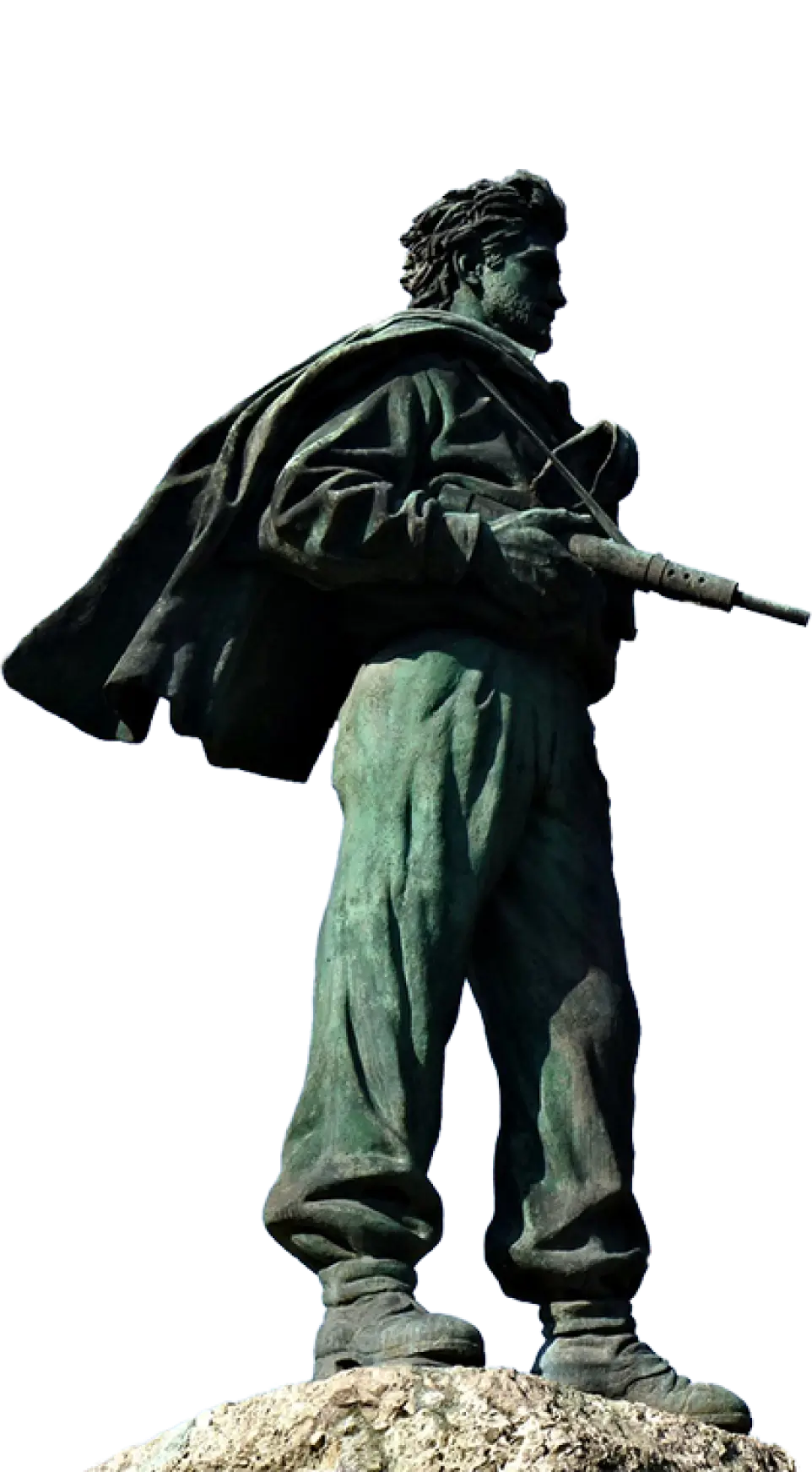
DESCRIPTION: The Partisan stands proudly on a large block of Sarnico stone at the center of the composition, with his cloak billowing and a submachine gun in his hand. Behind him stands the execution wall, built with bricks from a house destroyed by the 1944 bombings. Beside the wall lies the partisan who has just been executed, stretched out on the ground, dying, barefoot, with his shirt open and his hands tied behind his back. His head is turned backward in the spasms of death; the body conveys both suffering and dignity.
The statue was commissioned by the Partisan Associations in memory of the partisans who fought with courage, saw their comrades die, and struggled with all their strength to achieve freedom. The monument reminds everyone who passes through the streets of Parma of the fight for freedom against Nazism and Fascism, and of the importance of standing up for one's ideals, just as the partisans did during the Second World War.
The competition announced in 1954 by a committee formed by the Province, the Municipality of Parma, and the Partisan Associations was won by the project of the architect Guglielmo Lusignoli. The statue was created by the sculptor Marino Mazzacurati and inaugurated in 1956 during a major ceremony attended by the then President of the Italian Republic, Giovanni Gronchi.
Since then, it has become one of the city's most important monuments. In 1961, it was the target of an act of vandalism: the statue of the dying partisan, which had been severely damaged, was replaced with a copy, while the original, after being restored, was placed in the Villetta Cemetery, where it remains today. Mazzacurati, although not from Parma, chose to be buried beside the statue.
Another bronze version of the executed partisan has been on display since 1998 at the National Gallery of Modern and Contemporary Art in Rome.
In Parma, Emilia-Romagna
Partigiano
WHO WERE THE PARTISANS
A partisan is an armed fighter who does not belong to a regular army but to a resistance movement, usually organized into bands or groups, fighting against one or more regular armies through asymmetric warfare. The literal meaning of the word is "one who takes a side," referring to a person aligned with one of the parties involved in a conflict. In Italy, the term "partisan" refers to the members of the Resistance movement that developed in the territories occupied by the Axis powers (Germany, Japan, and Italy) during the Second World War.
A partisan struggle is a defensive war waged by civilians against the military occupation, conquest, or colonization of a territory. Its legitimacy was recognized by the 20th United Nations General Assembly (1965), which affirmed "the legitimacy of the struggle of peoples under colonial domination to exercise their right to self-determination and independence," while calling upon "all States to provide moral and material assistance to national liberation movements in colonial territories."
What distinguishes a partisan from a soldier, beyond the irregular nature of their organization, their greater mobility, and their political commitment, is their strong connection to the territory they defend, which usually corresponds to their own cultural community.
THE ITALIAN RESISTANCE
The Italian Resistance, also known as the Resistance, the Partisan Resistance, or the Second Risorgimento, was the collection of political and military movements that, following the Armistice of Cassibile (signed on September 3, 1943), fought against the Nazi-Fascist forces for the liberation of Italy during the Second World War.
The Resistance movement brought together people from a wide range of political backgrounds—including communists, members of the Action Party, monarchists, socialists, Christian democrats, liberals, republicans, and anarchists—most of whom united within the National Liberation Committee (CLN). The parties that formed the CLN later established Italy's first post-war governments.
The period of the Resistance began after the armistice of September 8, 1943 (the CLN was founded on September 9) and ended in the first days of May 1945, lasting approximately twenty months. April 25, 1945, commemorated today as Italy's Liberation Day, marks the date on which the National Liberation Committee for Northern Italy (CLNAI) called for the armed insurrection in Milan, headquarters of the partisan command in Northern Italy.
The origins of the Italian Republic are closely linked to the Resistance. The Constituent Assembly was composed largely of representatives of the political parties that had formed the CLN. As a result, the Italian Constitution was built upon a synthesis of their different political traditions and inspired by the principles of democracy and anti-fascism.
The experience of the Resistance has inspired numerous works of Italian literature, many written by authors who personally experienced the Second World War and the partisan struggle, including A Private Matter by Beppe Fenoglio, The Path to the Nest of Spiders by Italo Calvino, Agnese Goes to Die by Renata Viganò, Fausto e Anna by Carlo Cassola, and Tiro al piccione by Giose Rimanelli.
Also discover:
Silenus Group
Listen to the statue by calling
+39 0521 183 0424,
or click the button below