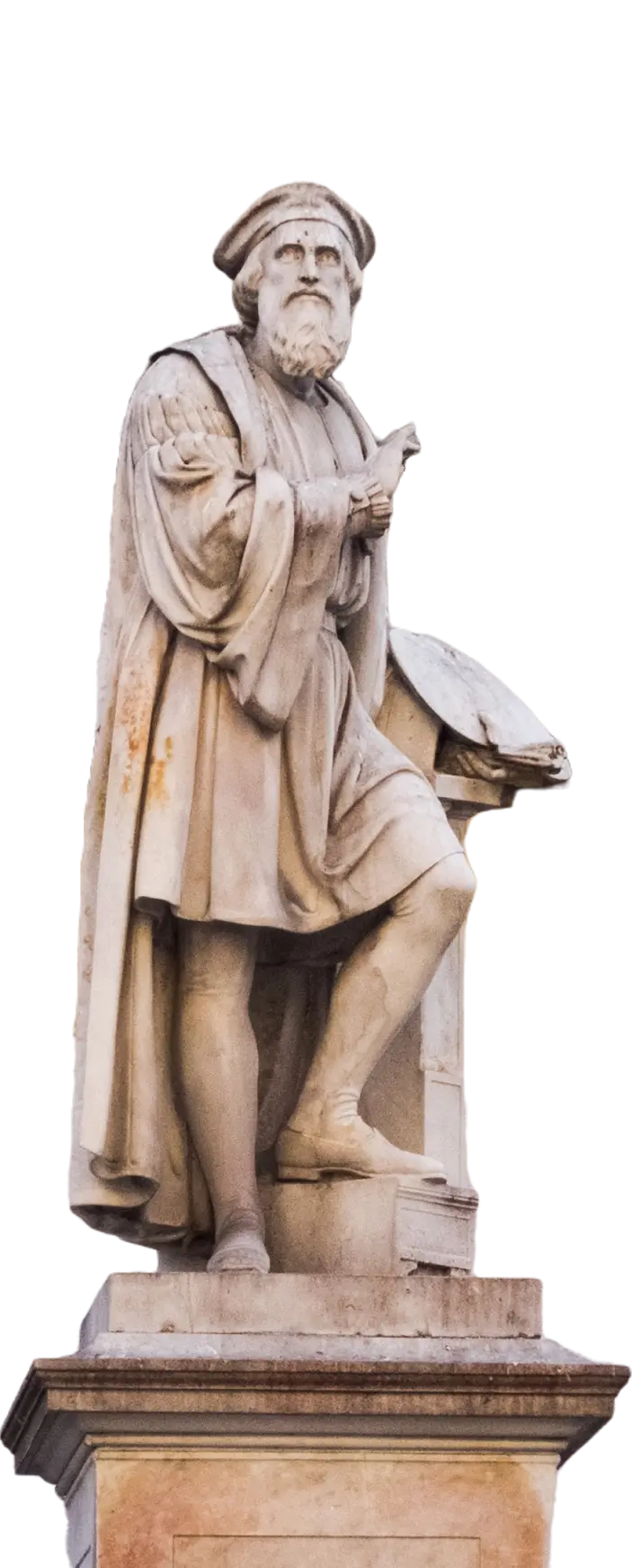
Realized by
Giovanni Chierici
1830 - 1917
Monument history
INAUGURATION: 1879
DATE OF INSTALLATION: The monument was inaugurated on September 6, 1879.
MATERIALS: The monument is entirely made of Carrara statuary marble.
CONSERVATION STATUS: Having survived the bombings of the Second World War, the monument was restored in 1992 with the support of Banca Popolare di Milano, whose Parma branch is located opposite the square.
The monument consists of a high square pedestal measuring approximately 3 metres on each side, shaped into three tiers above the plinth and decorated with frames and mouldings. The uppermost tier serves as the base for the statue of Parmigianino.
On the second tier of the pedestal are two shell-shaped basins that collect the water jets of a fountain flowing from two fully sculpted heads.
On the remaining two sides, within identical frames, are the inscriptions. On the north side: "The Municipality erected [this monument]"; on the south side: "The Constantinian Order contributed to the expense." Above the two fountains are engraved the dedication "To Parmigianino" and the date of the monument's installation in Roman numerals: "MDCCCLXXIX."
At the top of the pedestal stands the 2.20-metre-high statue of the painter, depicted while painting, holding a palette in one hand and a paintbrush in the other, which is no longer present.
NOTES AND HISTORICAL BACKGROUND: The present-day Piazza della Steccata was originally intended to host a monument to Cavour, one of the principal figures of the Italian Unification. In 1861, the Municipality launched a public subscription to fund its construction.
As the funds raised proved insufficient, the project was abandoned until 1876, when the then Mayor of Parma, Marquis Guido Dalla Rosa, proposed erecting a monument to Parmigianino on the same site.
Thanks to contributions from subscribers, the Municipality, and the Constantinian Order of Saint George (owner of the adjacent Church of the Steccata and the square), a total of 9,000 lire was raised.
The monument was inaugurated on September 6, 1879, during an event entirely dedicated to the great artist.
The Prefect and the Mayor attended the inauguration. The following year, an iron fence was installed around the monument to protect the pedestal. It was later removed in 1939 and reused for wartime purposes.
In Parma, Emilia-Romagna
Parmigianino
1503 - 1540
Girolamo Francesco Maria Mazzola, better known as Parmigianino, was born in Parma in 1503.
The son of the painter Filippo Mazzola, Parmigianino was trained in drawing and painting in the workshop of his paternal uncles, as his father died when he was only two years old. From an early age, he displayed extraordinary talent, and his works would later become symbols of the refinement and elegance characteristic of Mannerism.
His artistic development was undoubtedly influenced by Correggio, his contemporary. Although subtle, this influence can be seen, for example, in the frescoes of the "Room of Diana and Actaeon" in the Rocca Sanvitale of Fontanellato, which recall Correggio's frescoes in the Camera di San Paolo in Parma. These works, painted between 1523 and 1524, are considered among the artist's youthful masterpieces.
In 1524, Parmigianino moved to Rome, where he met several of Raphael's pupils and young Tuscan painters. During this period, a new artistic movement emerged in Rome that would later spread throughout Italy and to several French courts: Mannerism. In contrast to the harmonious ideals of the Renaissance, Mannerism developed a refined yet unconventional style, characterized by elongated figures in complex poses and the use of vivid colors.
While in Rome, Parmigianino produced numerous works, and Pope Clement VII commissioned him to fresco the Hall of the Pontiffs in the Vatican, a project that was never completed. In 1527, the young painter was taken prisoner during the Sack of Rome. After regaining his freedom, he moved to Bologna, where he devoted himself to printmaking and learned the etching technique from Antonio da Trento. He refined this technique first in Bologna and later in Parma, becoming one of its greatest masters.
After his stay in Bologna, Parmigianino returned to Parma, where he was commissioned to decorate the main chapel of the Basilica of Santa Maria della Steccata. Although left unfinished, these frescoes, painted between 1531 and 1539, represent the culmination of the increasingly refined, elegant, precious, and complex style that distinguished his mature work.
After producing many other important works, Parmigianino died in Casalmaggiore on August 24, 1540.
Also discover:
Partisan
Listen to the statue by calling
+39 0521 183 0423,
or click the button below