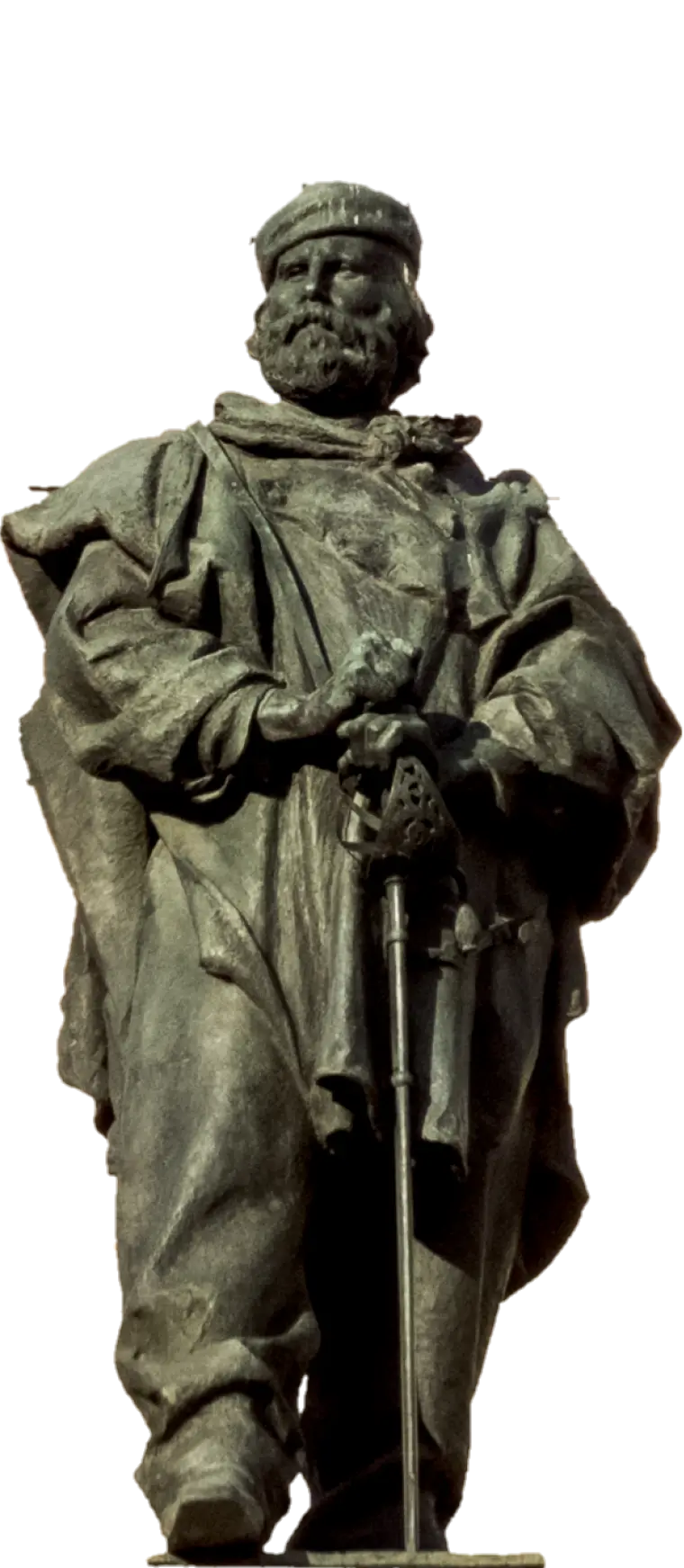
Realized by
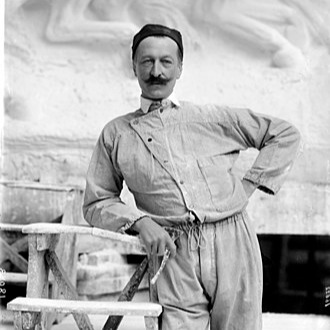
Davide Calandra
1856 - 1915
Monument history
The history of the monument dedicated to Giuseppe Garibaldi began after the general's death in 1882, when the newspaper Il Presente launched a public subscription to erect a statue in his honor. On January 24, 1887, once the necessary funds had been raised, the Municipality of Parma published the first competition notice for the creation of the monument. The statue was to be made of white Carrara marble, placed on a pedestal of the same material or of red Baveno granite, at a total cost of 20,000 lire.
The monument was originally intended for Piazzale delle Piante, near the Reinach Theatre (today Piazzale della Pace). The models submitted for the competition were exhibited at the Teatro Regio for fifteen days. The proposal selected by the Academy, which had been appointed to evaluate the entries, was not approved by the Municipality, which instead decided to launch a second competition. This was won by the project of Davide Calandra.
The original model differed considerably from the present monument. Garibaldi was depicted standing on a rocky spur, leaning on a curved sword. This solution was considered unsuitable, and Calandra was asked to remove the rocky outcrop. It was also decided that the monument should be cast in bronze, making an additional fundraising campaign necessary because of the higher costs.
Calandra therefore created a new model in which Garibaldi appeared bareheaded, but this version was also rejected by the artistic commission.
The sculptor then produced a third model in which the general's figure appeared more imposing. This time the design was approved, and the bronze casting could proceed at the Sperati Foundry in Turin.
LOCATION
Meanwhile, the promoting committee obtained permission for the monument to be placed in the present-day Piazza Garibaldi, considered a more prestigious location than the one originally chosen. The statue of Garibaldi took the place of the Altar of Friendship, a monument designed by the French architect Ennemond Alexandre Petitot to commemorate a visit by the Emperor of Austria to Parma, which had been demolished and removed in 1859.
INAUGURATION
On the occasion of the inauguration of the monument to Giuseppe Garibaldi in 1893, two distinguished citizens of Parma, Professor Oreste Boni and Member of Parliament Cornelio Guerci, composed a hymn that was performed during the procession from the Ducal Park to Piazza Garibaldi.
Entry by Emanuela Chierchia and Giovanna Sagliano. Bibliography: G. Gonizzi, La città e la Gloria I. Protagonisti, arte e storia dei monumenti di Parma, Parma, MUP, 2014.
Edited by Paola Morgia and Daniele Napodano.
Bibliography
R. Belmondo, M. Lamberti, Davide Calandra. L’opera. La Gipsoteca, Savigliano, 2004.
M. Campra, Tesori d’arte a Savigliano, Savigliano, 2008.
In Parma, Emilia-Romagna
Giuseppe Garibaldi
1807 - 1882
GIUSEPPE GARIBALDI (1807–1882)
Garibaldi was one of the heroes of the Italian Risorgimento and dedicated his life to fighting for the unity and independence of Italy.
Born in Nice in 1807, he followed in his father's footsteps and became a sailor at a young age. During one of his voyages, he came into contact with the patriotic and republican ideals of Mazzini and joined the Young Italy movement. He later took part in a revolutionary uprising organized by Mazzini, which failed and led to his being sentenced to death. As a result, in 1835 he fled to Brazil, where he remained for twelve years.
SOUTH AMERICA
During this period, Garibaldi took part in revolts and uprisings in Brazil and Uruguay, earning a reputation as a remarkable military leader. His fame spread throughout Europe, where he became known as "the Hero of Two Worlds." In Latin America, he met Anita who, after leaving her husband, became his wife and lifelong companion, sharing both his ideals and his battles.
FIRST WAR OF ITALIAN INDEPENDENCE
In 1848, Garibaldi returned to Europe and took part in the First Italian War of Independence. He was entrusted with the defense of Rome, but after the defeat by the French army, the renowned commander was forced to flee Italy once again.
SECOND WAR OF ITALIAN INDEPENDENCE
His second exile lasted until 1854. After returning, he definitively distanced himself from Mazzini's republican ideals. For Garibaldi, Italy's independence and unity had become the highest priority, and for this reason he chose to support the monarchy led by Victor Emmanuel II of Savoy.
Garibaldi resumed contact with Cavour, who entrusted him with an important role in the Second Italian War of Independence fought by the Kingdom of Sardinia against Austria. The war ended with the annexation of Lombardy to the Kingdom of Sardinia, but this achievement was not enough for Garibaldi. He strongly criticized the House of Savoy for failing to continue the unification of the entire peninsula.
THE EXPEDITION OF THE THOUSAND
In 1860, Garibaldi decided to take advantage of an uprising that had broken out in Palermo. On the night between May 5 and 6, the Expedition of the Thousand departed from Quarto, without official approval but with the tacit consent of the monarchy. The expedition led by Garibaldi achieved one success after another: on May 27 Palermo fell into his hands; on August 19 he crossed the Strait of Messina, then marched victoriously through Calabria and finally reached Naples, where he entered the city together with Victor Emmanuel II on November 7.
On that occasion, he handed over the results of his campaign to the King, refusing the reward to which he was entitled. With the Expedition of the Thousand, Garibaldi accomplished the decisive step toward the unification of Italy, which was achieved in 1861 and completed in 1870 with the annexation of Rome and the Papal States.
Also discover:
Giuseppe Verdi
Listen to the statue by calling
+39 0521 183 0419,
or click the button below