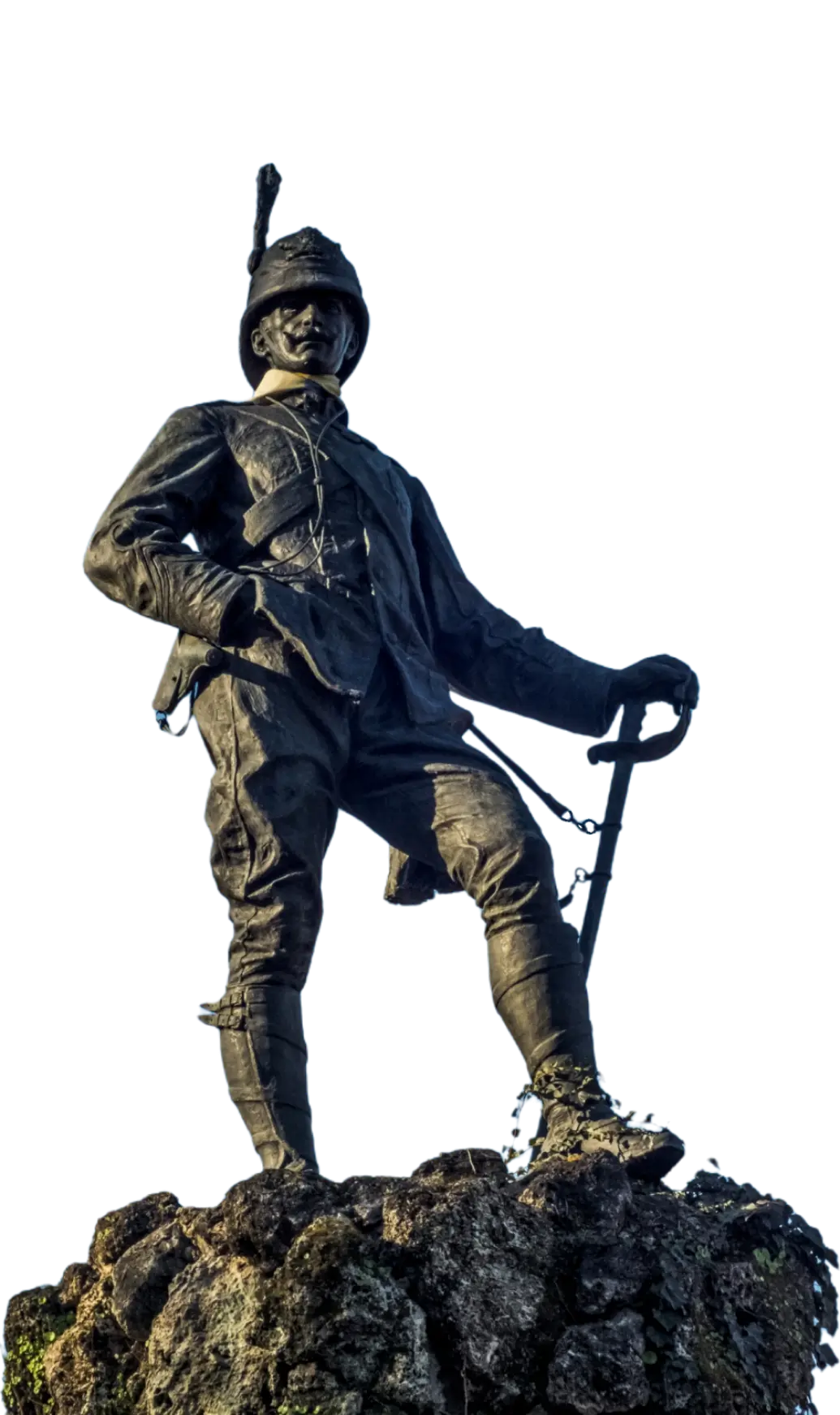
Realized by
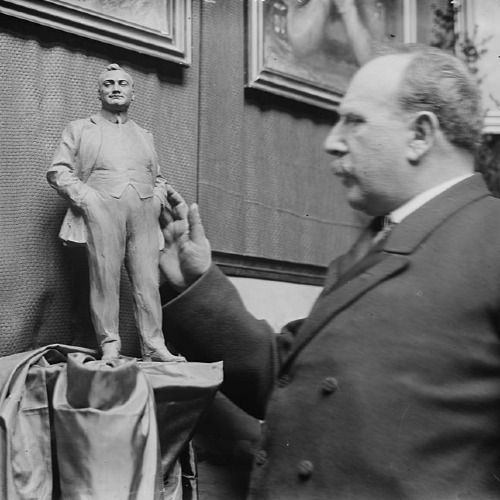
Ettore Ximenes
1855 - 1926
Monument history
INAUGURATION: 1907
The news of Captain Bottego's tragic death in 1897 deeply affected public opinion because of the great popularity of the explorer from Parma, whose ambition and desire to establish his reputation were supported by the government, which sought to promote its colonial policy through public approval. Fundraising committees for the monument were organized both in Italy and abroad. The decision to place the statue in front of the railway station offered visitors the image of a proud and patriotic city.
The monument was created in 1907 by the sculptor and friend Ettore Ximenes. The bronze was cast at the Artillery Construction Workshop in Turin.
The statue depicts the explorer in colonial uniform, standing on top of a small rocky hill from which water flows into two basins. On either side stand two Galla warriors on lower hills. They symbolize the Omo and Juba rivers, whose mouth and source were discovered by Bottego. Ximenes oriented the monument toward the east, with the inscription "To Vittorio Bottego / 1907", and beneath the allegorical river figures placed the inscriptions "OMO DEFLUENZA / 1896" and "GIUBA SORGENTI / 1893", together with their geographical coordinates, to celebrate the explorer's two scientific discoveries.
The inauguration took place on Thursday, September 26, 1907, with a large deployment of police forces because of the political tensions of the time and fears of protests against the "colonialist" monument.
The Bottego Museum was later inaugurated, housing collections of natural history specimens (invertebrates and vertebrates), ethnographic objects (Eritrean weapons), historical artifacts (a wooden mask and sacred manuscripts in Arabic), and documentary memorabilia (letters, notebooks, and photographs).
Following a careful restoration, in 2014 the statue was returned to its site within a redesigned architectural layout of the surrounding square, as part of the urban redevelopment and renovation of the entire railway station district, based on a project by the architect Oriol Bohigas.
In Parma, Emilia-Romagna
Vittorio Bottego
1860 - 1897
Vittorio Bottego was born in Parma on July 29, 1860, into a wealthy family. A restless and adventurous young man, he enrolled in the Military Academy and became an army officer. Fascinated by the world of exploration, he requested a transfer to Eritrea, from where he led scientific and geographical expeditions on behalf of the Italian Geographical Society (SGI).
1891 – Danakil: Bottego explored the desert region overlooking the Red Sea, from which the African Rift Valley extends. At the time, this remote area was almost inaccessible and largely unknown. Thanks to his surveys, new maps of the coastline were produced and several previously unknown animal species were studied.
1892 – Juba River: During this year-long expedition, Bottego lost nearly 90% of his team due to desertion, disease, and attacks. Despite these hardships, he successfully mapped the course of the river and collected important scientific and natural history specimens, now preserved at the Natural History Museum of Parma. Upon his return to Italy, he received the Gold Medal of the Italian Geographical Society and the Silver Medal for Military Valor from the Italian government. His journey was later described in the book The Explored Juba, a work combining geographical, ethnographic, and naturalistic observations.
1895 – Omo River: In addition to discovering the river's outlet into Lake Turkana, the expedition aimed to establish peaceful relations with the local populations by signing treaties that would make the region safer.
Bottego continued exploring Ethiopian territory, but, partly because of his impetuous character, became involved in a conflict with the Galla-Oromo people, during which he was killed on March 17, 1897. The surviving members of the expedition later published The Bottego Omo: An Expedition in Eastern Africa. Despite the heavy losses and the serious disagreements within the expedition—particularly with Captain Grixoni—the scientific achievements were significant, and Bottego came to be recognized as one of the leading explorers of Africa.
In 1907, the city of Parma dedicated a monument to him, created by his friend, the sculptor Ettore Ximenes.
Also discover:
Hercules and Antaeus - Original
Listen to the statue by calling
+39 0521 183 0413,
or click the button below