Monument history
Creation: 1687
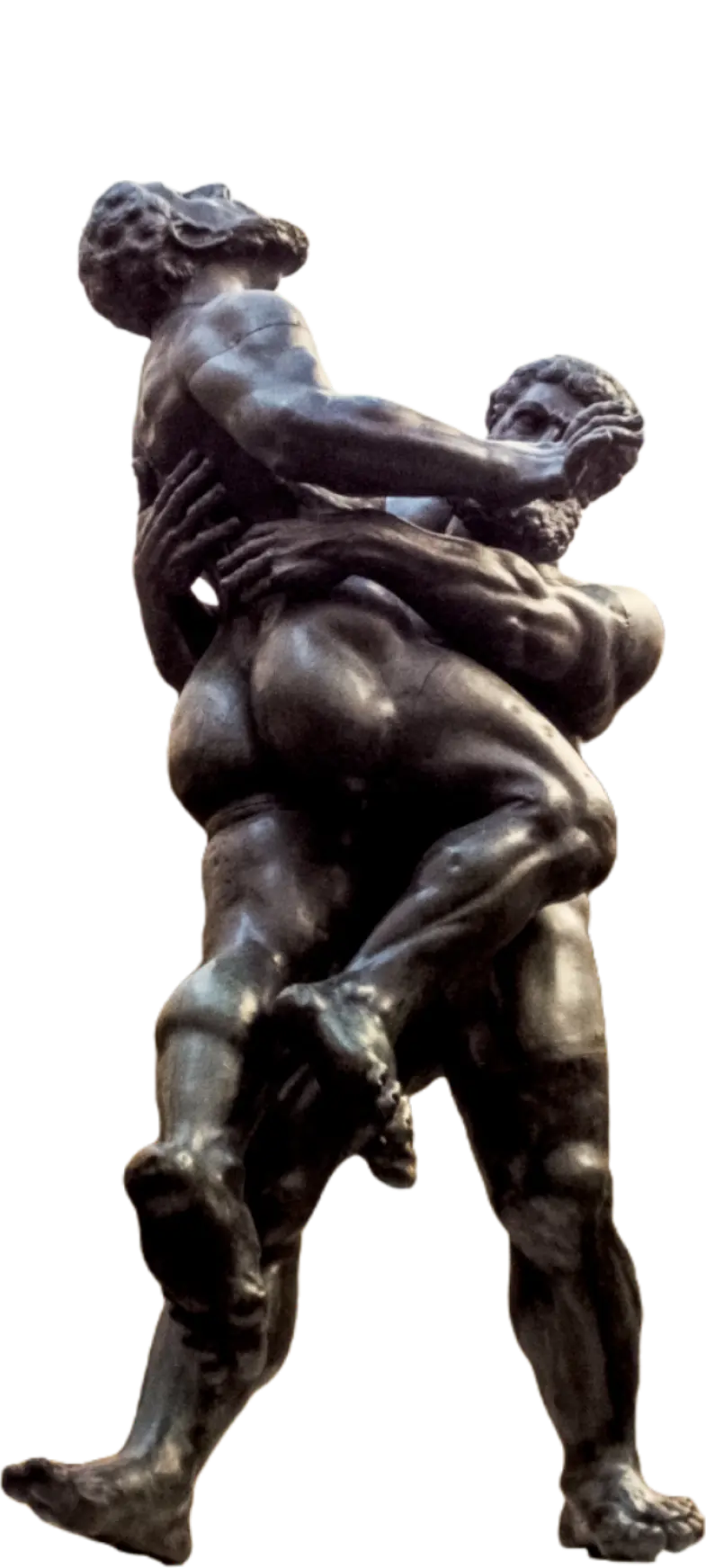
The copper sculptural group of Hercules and Antaeus was created between 1684 and 1687 by the Flemish sculptor Van der Struck, based on a design by Reti, at the ducal forge in Colorno. The statue, depicting the struggle between the mythological hero Hercules and the giant Antaeus, was intended to form an integral part of a fountain, with water flowing directly from Antaeus's mouth.
Today, the original is located in the center of the courtyard of Palazzo Cusani, known as the House of Music, while the copy stands in Via Repubblica, attached to the Town Hall building in Parma.
The statue was commissioned by Ranuccio II Farnese in 1684 to decorate a new fountain in the Ducal Garden. At that time, extensive work was carried out to redesign the park in preparation for the wedding of Ranuccio's son, Odoardo III. The work was completed only in 1689, although the inscription on Antaeus's foot is dated 1687.
The statue's journey through the city
The statue was dismantled around the mid-eighteenth century during Petitot's renovation of the garden. In May 1784, Count Cesare Ventura requested the sculptural group from Duke Ferdinand so that it could be placed beneath the loggia of the inner courtyard of the Government Mint Palace, now the House of Music.
The statue was moved again during the Napoleonic rule to the courtyard of the Ducal Garden Palace, beneath the willows on the island of the ornamental pond. Around 1824, after the end of Napoleonic rule, the monument was transferred to the storerooms of the Ducal House.
In 1829, the "du brasè", as the statue is known in the local dialect, found a new home on the municipal fountain in Via Repubblica, at the request of the Mayor of Parma, Lucio Bolla. He decided to place it in a niche on the eastern side of the Town Hall, above a fountain later created by the marble craftsman Galli, based on a design by the architect and engraver Paolo Toschi.
For more than a century, Hercules and Antaeus watched carts and horses, automobiles and scooters pass by, remaining motionless through changing times, though not immune to the effects of pollution.
On New Year's Day 1981, vandals removed Antaeus's arm. In 1987, the statues were removed and underwent restoration by the Parmese sculptor Jucci Ugolotti, with the aim of creating a bronze copy to replace the original in Via Repubblica. The original was then returned to the House of Music, where it still stands today in the center of the courtyard.
In Parma, Emilia-Romagna
Hercules
Hercules and Antaeus challenged each other to combat. As they prepared for the fight, they removed their lion skins. Hercules anointed his body with oil so that he could more easily slip from his opponent's grasp, while Antaeus rubbed his limbs with warm sand, fearing that the mere contact of his feet with the earth would not be enough to restore his strength.
The battle began. Hercules threw the giant to the ground, but to his great astonishment he saw Antaeus's muscles swell and his blood surge through his body, for Mother Earth was restoring his strength. The two grappled again, and once more Antaeus deliberately threw himself to the ground before Hercules could overpower him. Realizing what was happening, Hercules lifted the giant into the air and crushed his ribs until he died.
Antaeus
Antaeus was a giant, the son of Poseidon and Mother Earth. He lived in Libya and challenged every stranger to wrestle with him until they were exhausted, only to kill them afterward. He was not only strong and skilled, but every time he touched the ground, his strength was renewed. He kept the skulls of his victims to build the roof of a temple dedicated to Poseidon.
Antaeus was no easy opponent to defeat. He lived in a cave at the foot of a rocky peak, fed on lion's flesh, and slept directly on the bare earth to preserve and increase his immense strength. Mother Earth had conceived him in a Libyan cave and was prouder of him than of her other monstrous sons, Typhon, Tityos, and Briareus.
Also discover:
Ariadne
Listen to the statue by calling
+39 0521 183 0427,
or click the button below