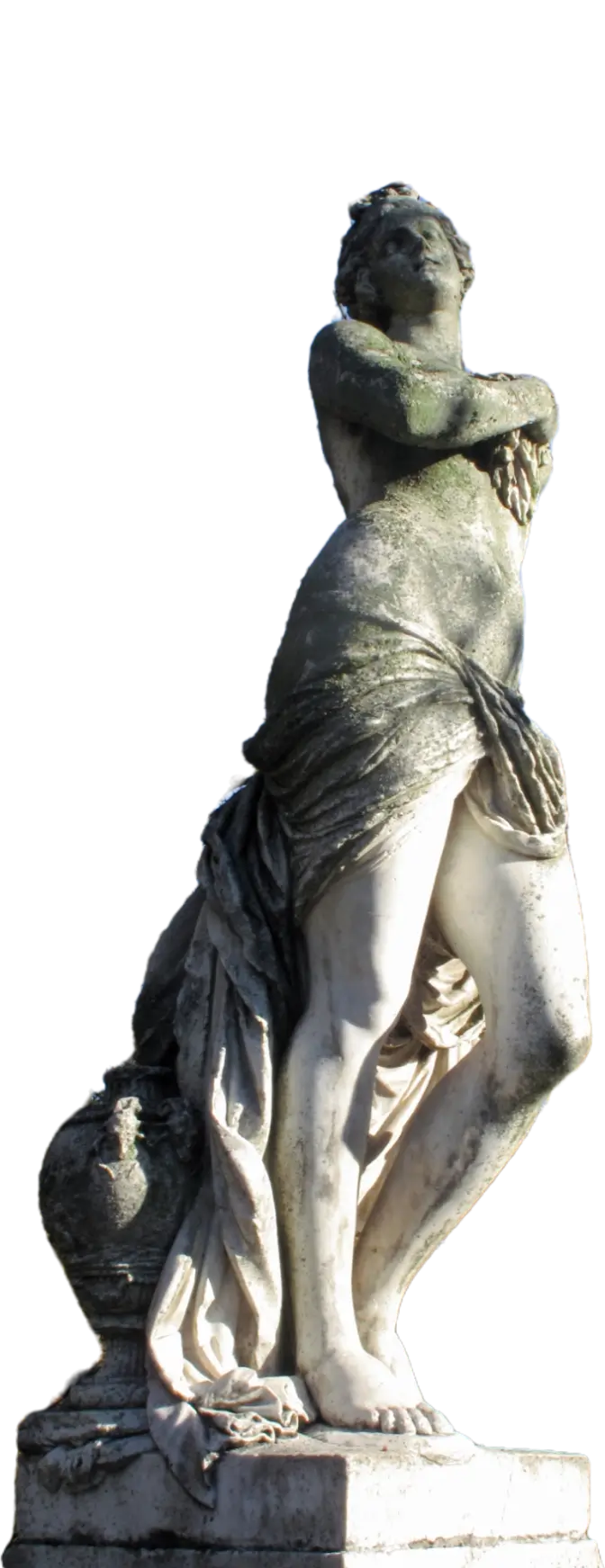
Realized by
Jean-Baptiste Boudard
1710 - 1768
Monument history
In 1748, Philip of Bourbon and his wife Louise Élisabeth of France became Duke and Duchess of Parma, respectively. From that time onward, Parma experienced a new period of cultural splendor, following the one it had enjoyed during the Renaissance thanks to the Farnese family.
As the Duchess was French, many prominent figures came from France to settle in Parma and enrich the city politically and culturally. One of them was Guillaume du Tillot, Minister of Culture during the reign of Philip and Louise Élisabeth. Du Tillot brought two great artists from France: the architect Ennemond Alexandre Petitot and the sculptor Jean-Baptiste Boudard.
Boudard was appointed "First Court Sculptor" and "Superintendent of Sculpture and Ornamentation for the Duke," creating numerous works for Parma as well as for the Royal Palace of Colorno. Between 1754 and 1765, he sculpted the marble statues for the Ducal Garden, including Ariadne, the group of Silenus, Zephyr, Flora, Apollo, and the series of the Great Vases.
Many of his sculptures are preserved just a short walk from the Ducal Garden at the Toschi Art Institute and the Parmense Academy of Fine Arts, founded by Du Tillot, where the artist taught alongside Petitot. Other works that can still be admired in the city include the Crowned Virgin in the niche of the Governor's Palace in Piazza Garibaldi and the vases of the Casinetto along Viale Martiri della Libertà.
Boudard died at the age of 58 in Sala Baganza, in the province of Parma, where he had retired to seek treatment for dropsy. He was buried in the parish church, where he is commemorated by a memorial plaque.
In Parma, Emilia-Romagna
Ariadne
Ariadne was a princess born in Knossos, the capital of the island of Crete. Her father was King Minos and her mother was Pasiphaë. Because of a curse placed upon her by Poseidon, Pasiphaë gave birth to the Minotaur: a terrifying creature with a human body but the fur, tail, hooves, and head of a bull. Minos imprisoned the Minotaur in the Labyrinth of Knossos. The monster fed on human flesh, and every year seven young men and seven young women were sent from Athens to Crete as a sacrifice. One day, however, a young Athenian arrived in Crete, determined to kill the Minotaur. His name was Theseus.
From this point onward, the myth of Ariadne branches into several different versions. The best-known and most widespread version (the one we followed in creating our audio guide) tells that Ariadne fell in love with Theseus at first sight and helped him accomplish his task, giving him a sword coated with poison and a ball of thread to unwind as he entered the labyrinth, allowing him to find his way back out.
The princess then fled with the young Athenian, who had emerged victorious from the labyrinth. Shortly after their departure, however, Theseus abandoned Ariadne on the island of Naxos while she was asleep. The princess was rescued by Dionysus, whom she later married, and lived happily with him. After Ariadne's death, Dionysus placed the crown he had given her on their wedding day among the stars, thus creating the "Crown of Ariadne" constellation.
Let us now look at some other versions of this myth.
- Let us begin with Theseus' abandonment of Ariadne: why did it happen?
- According to the best-known version, it happened simply because the prince of Athens was something of a womanizer and wanted to rid himself of Ariadne in order to pursue other love affairs.
- According to another version, however, Theseus was forced to abandon Ariadne by the god Dionysus himself, who had fallen in love with her and, appearing to the young prince in a dream, ordered him to leave her so that she would belong only to him.
- According to another tradition, there was no abandonment at all. Deeply in love with Ariadne, Theseus made her pregnant on their first night together. Since she was suffering from seasickness and the discomforts of pregnancy, he landed her on the island of Cyprus while waiting for her to give birth. Ariadne died in childbirth, leaving Theseus devastated by grief.
- There are also conflicting accounts concerning the island of Naxos, where Ariadne is traditionally said to have been abandoned:
- some claim that the abandonment actually took place on an island called Dia, meaning "the Shining One," located only a few kilometers from Knossos;
- furthermore, even if Naxos is accepted as the correct location, it is often described as a desolate and almost uninhabited place, symbolizing Ariadne's despair at the moment of her abandonment. Historical sources, however, describe it as a flourishing and civilized island.
The existence of so many versions of the same myth is the result of the oral tradition through which these stories were passed down for centuries before being written down and preserved in a stable form for future generations.
An interesting curiosity concerns the name of the island itself: since Ariadne was supposedly abandoned on Naxos, it is widely believed that the Italian expression "piantare in asso" ("to abandon someone") originated from this story.
Also discover:
Arturo Toscanini
Listen to the statue by calling
+39 0521 183 0416,
or click the button below