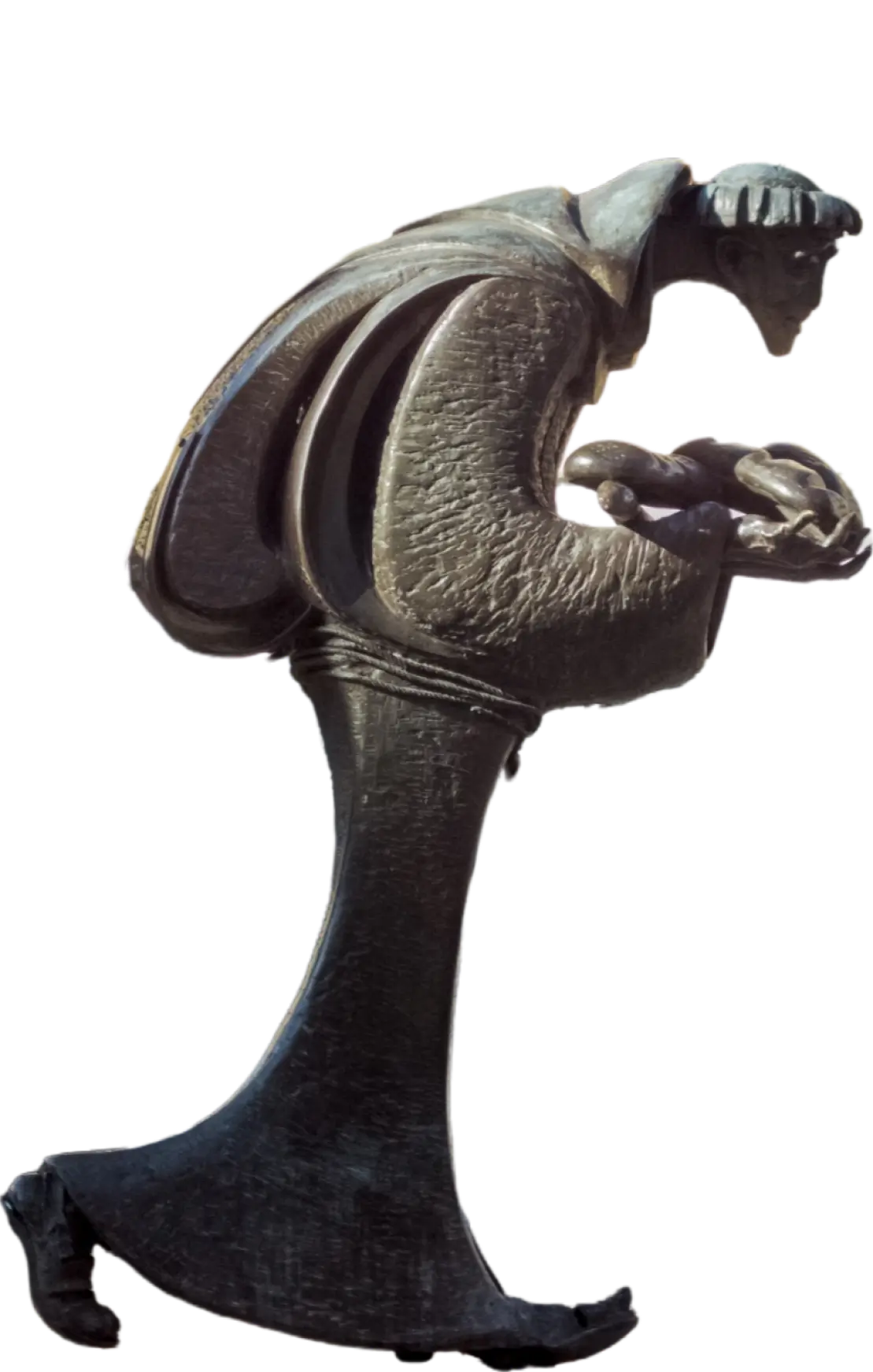
Realized by
Jucci Ugolotti
Birth: 1944
Monument history
INAUGURATION: 1998
During the 1990s, although there were already many memorials dedicated to Father Lino throughout the city, there was still no significant monument in his honor. For this reason, the association "Amici di Padre Lino" included among its objectives the creation of a statue to be placed in a street or square in Parma.
In May 1991, the association's council commissioned the sculptor Jucci Ugolotti to create the statue. In June 1995, she presented several preliminary models to the council, which approved them, allowing the work to proceed. The location of the monument, however, was still undecided.
The following year, the statue was presented to the city and temporarily displayed in the central nave of Parma Cathedral.
It was immediately clear that this was a modern, stylized sculpture, completely different from the one located in the Villetta Cemetery. The bronze figure of Father Lino is shown leaning forward while offering large loaves of bread.
Meanwhile, the Municipal Administration authorized the placement of the monument in the center of Piazzale Inzani, in the heart of the Oltretorrente district, where Father Lino had lived and carried out most of his work. It stands on a section of cobblestone pavement, facing the Old Hospital, where the friar had cared for hundreds of patients.
Sadly, despite the message of love conveyed by the statue, in September 2011 the bronze loaves of bread were stolen. They were promptly recovered thanks to the intervention of the police, making it possible to restore them and return them to the statue's arms in May 2014. The restored monument was returned to the city in its original splendor on the occasion of the ninetieth anniversary of the friar's death.
Following these acts of vandalism, and to prevent further incidents, the lighting around the monument was increased and a video surveillance system was installed.
Visiting the statue has a special meaning because of the message it conveys to the community: Father Lino is a hero of charity and reminds everyone of the value of solidarity, of which he was an extraordinary witness.
SOURCES:
Giancarlo Gonizzi, La Città e la Gloria I. Protagonisti, arte e storia dei monumenti di Parma.
In Parma, Emilia-Romagna
Padre Lino
1866 - 1924
Alpinolo Ildebrando Umberto Maupas, better known as Padre Lino, was born in Split (Croatia) on August 30, 1866. He was of French descent on his father's side and Abruzzese descent on his mother's. After completing his novitiate with the Franciscans in Koper, he became a friar in 1882. Four years later, however, he was forced to leave the convent because of a series of minor breaches of the rules, including playing the piano. After returning home, he enlisted in the Italian Financial Police, but following the tragic death of a man who had stolen food for his family, he realized that this was not the life he wanted. In 1888, he asked to be readmitted to the Franciscan Order, taking the name Fra Lino. Two years later, he was ordained a priest in Rimini, but worsening eyesight forced him to move to Bologna for treatment.
In 1893, he arrived in Parma and was assigned to the Convent of the Santissima Annunziata. At the time, Parma was deeply divided by social and economic inequalities. Wealthier citizens lived in the historic center around Piazza Garibaldi and Piazza Duomo, while poverty, hunger, and crime were widespread in the Oltretorrente district. Padre Lino worked among both communities, helping to bridge this divide, and became one of the city's most beloved figures. He was a friend to everyone: to the wealthy, who supported his charitable work, and above all to the poor, the uneducated, children, and prisoners, whom he constantly visited and assisted.
He was appointed chaplain of the San Francesco Prison and later of the juvenile reformatory at the Certosa, where he devoted himself to helping those most in need.
He died near the Barilla pasta factory on May 14, 1924, while searching for a job on behalf of an unemployed young man. More than 30,000 people—virtually the entire population of Parma at the time—attended his funeral, and his coffin was built by the prison inmates. He was buried in Parma's Villetta Cemetery and, in 1999, was declared Venerable by the Catholic Church.
Today, a soup kitchen in Parma that provides hot meals to people in need bears his name.
Also discover:
Giuseppe Verdi's bench
Listen to the statue by calling
+39 0521 183 0417,
or click the button below